AI can do the work. It can't hold the licence.
AI can already take on much of the groundwork behind a lender, a law firm, a clinic or a tax practice. It can't be the licensee, the registered practitioner or the person who answers for the work. Every Australian licence traces back to named, qualified people, and several of those registers are shrinking.
Mitch Flindell · 28 September 2026 · 13 min read · Journal
An AI system can read a borrower's bank statements, sort every transaction, check the payslips against the application and draft the serviceability assessment before anyone has finished their coffee. It still can't hold the credit licence.
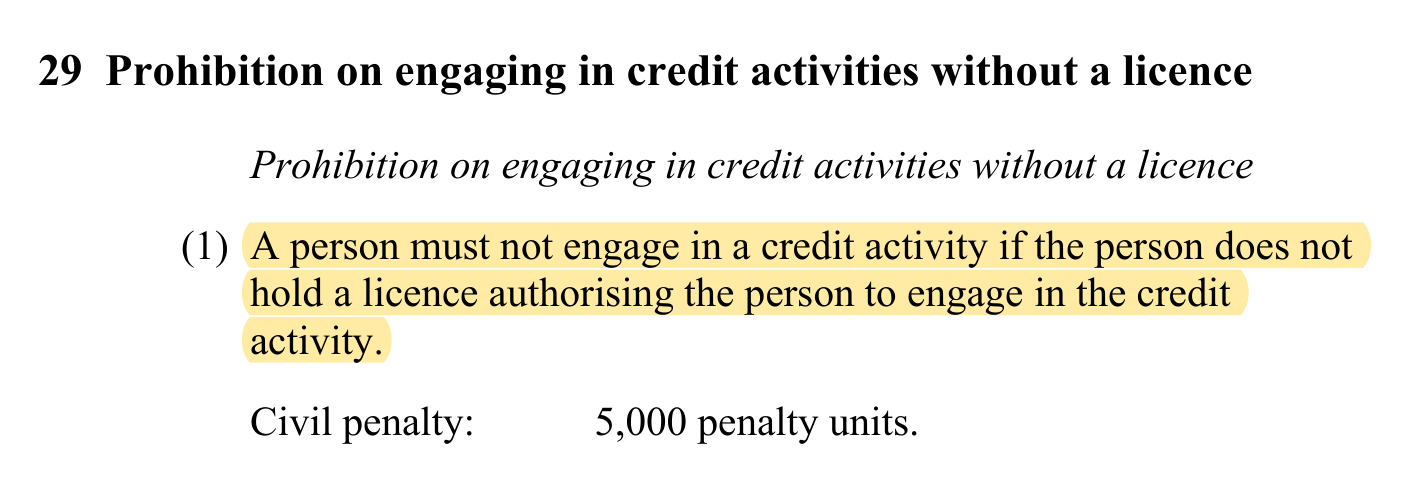
Section 29 of the National Consumer Credit Protection Act says it plainly: "A person must not engage in a credit activity if the person does not hold a licence authorising the person to engage in the credit activity"1. Breaching it carries a civil penalty of 5,000 penalty units, and the matching offence carries two years in prison1. A company can hold the licence, and its employees and credit representatives can act under it1. But the licence is built around people. ASIC must have no reason to believe the applicant, its officers or the people who control it are not fit and proper1, and it expects named responsible managers with credit experience, qualifications and at least 20 hours of professional development a year2.
The same pattern runs through almost every regulated business we work with. Software can do more and more of the work. It can't be the licensee, the registered practitioner or the person who answers for the work. We think that single fact explains more about where regulated businesses are heading than any benchmark does.
Key numbers
- ▪Registered company auditors fell from 7,736 in 1999 to 3,073 in 2025, down 60%5. Only a natural person can apply to register as an auditor (Corporations Act, s 1279)23.
- ▪Of the 15,179 financial advisers with a current role in ASIC's September 2026 data, 14,658 had registered status7.
- ▪153,963 medical practitioners were on the Medical Board's register at 30 June 2026, including 5,058 who were non-practising31.
- ▪The Department of Health's nursing study projects a baseline undersupply of 70,707 full-time-equivalent nurses by 2035 if nothing changes14.
- ▪97,500 practising solicitors in October 2024, up 47% in ten years, but the share in country and rural areas fell from 12.5% to 8.8%17.
- ▪On AI, the migration agents regulator says of the rules on immigration assistance: "There are no exemptions, including information generated through AI"25.
Software can already do much of the groundwork
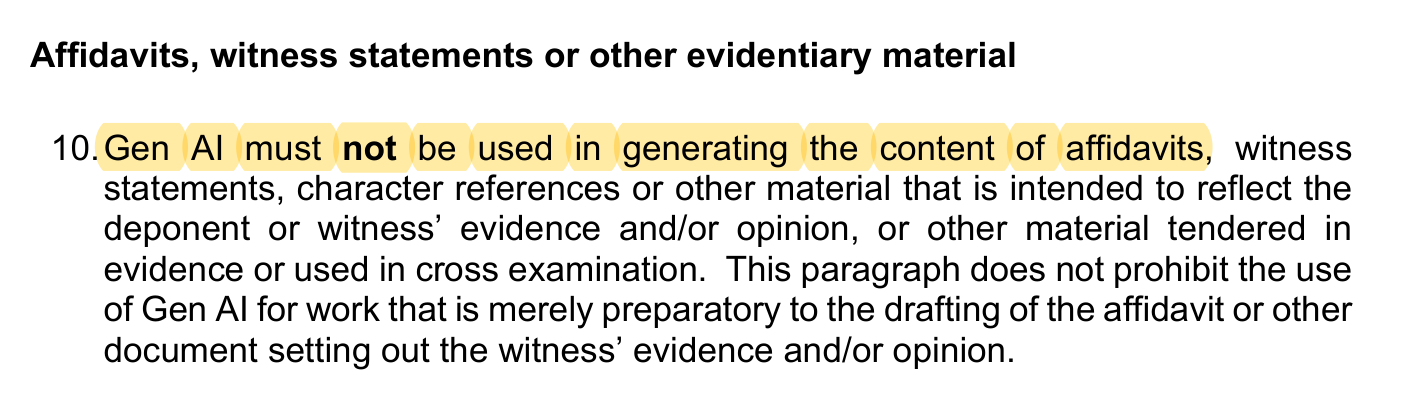
This isn't a claim that AI is weak. Regulators describe what it can do in plain terms. The Tax Practitioners Board's July 2026 guidance lists AI functions that operate "without continuous human intervention" and the "auto-compiling of a tax form", and says AI tools used appropriately "provide a significant opportunity to increase productivity"22. The NSW Supreme Court's practice note allows generative AI for chronologies, indexes, witness lists, summaries of documents and draft submissions, but not for the content of affidavits or witness statements18. Jobs and Skills Australia found that current generative AI is more likely to augment work than automate it, and that "the higher potential for automation is concentrated in routine clerical and administrative roles"26.
That groundwork fills the day in a clinic, a practice, a lender or a claims team: reading forms, checking them against rules, chasing what's missing and keying it in somewhere else. We've written separately about what an agent can do in Medicare billing. The July 2026 Medicare Benefits Schedule Book alone runs to 1,760 pages39. Software can check a claim against all of it. No person can hold it all in their head.
What software can't do is carry the licence.
Every licence traces back to a person
Go through the licensing laws behind Australia's regulated industries and the same words keep appearing: "an individual", "a natural person", "fit and proper". Some licences can only be held by an individual. Others can be held by a company, but only with named, qualified people behind it: responsible managers, directors, principals, registered agents. None of them can be held by software.
| Activity | Who can hold it | Law | Maximum penalty if unlicensed | On the register |
|---|---|---|---|---|
| Lending and other credit activity | A licensee, which can be a company; its officers and controllers face a fit and proper test (s 37A)1 | NCCP Act s 291 | 5,000 penalty units (civil); 2 years' prison (offence)1 | 4,466 licences, June 20255 |
| Medicine and other registered health professions | Individuals only: "An individual is eligible for general registration" (s 52)9 | National Law ss 52, 1139 | Using a protected title: $60,000 or 3 years' prison (individual); $120,000 (company)9 | 153,963 doctors, June 202631 |
| Billing Medicare | Individual practitioners, a provider number for each practice location12 | Health Insurance Act s 19AA33 | No Medicare benefit can be claimed without one12 | n/a |
| Legal practice | Admitted lawyers with a practising certificate (only an individual can be admitted, s 16), or a qualified entity such as a law practice1634 | Legal Profession Uniform Law s 1034 | 250 penalty units or 2 years' prison16 | 97,500 solicitors, Oct 202417 |
| Tax agent services for a fee | Individuals; companies and partnerships only with enough individual registered agents (s 20-5)21 | Tax Agent Services Act s 50-521 | 250 penalty units (individual); 1,250 (company), civil21 | 63,865 registrations, June 202541 |
| Personal advice to retail clients | Individuals only: a "relevant provider" (s 910A), registered with ASIC (s 921Y)23 | Corporations Act s 921Y23 | Civil penalty23 | 15,179 advisers, Sept 20267 |
| Deciding insurance claims | An AFS licensee or its representative, with named responsible managers; some roles exempt6 | Corporations Act ss 766G, 911A23 | 5 years' prison (s 911A)23 | n/a |
| Company audit | Natural persons only (s 1279)23 | Corporations Act ss 1279, 324BA23 | 6 months' prison (s 324BA)23 | 3,073 auditors, June 20255 |
| Acting as a liquidator | Individuals only (Insolvency Practice Schedule s 20-5)23 | Corporations Act s 53223 | 30 penalty units23 | 658 liquidators, June 20255 |
| Owning a pharmacy (Victoria) | Registered pharmacists, or companies wholly owned and directed by them; limited exceptions24 | Pharmacy Regulation Act (Vic) s 524 | 240 penalty units (individual); 1,200 (company)24 | 43,331 pharmacists (national), June 202642 |
| Immigration assistance | Registered migration agents, who must be individuals (s 288); also lawyers and some exempt people (s 280)32 | Migration Act s 28032 | 60 penalty units (strict liability)32 | 5,581 agents, June 202640 |
Most of these licences come with things only a person can carry: a character test, qualifications, continuing education, and the risk of losing the right to practise. Where a company holds the licence, those tests reach the people who run it. Software can't be struck off, and it can't stand in front of a tribunal.
Software can do the work. It can't be the one who answers for it.
Regulators have already answered the AI question
Australia has not written a separate AI law. The National AI Plan, released in December 2025, says the government's approach "will continue to build on Australia's robust existing legal and regulatory frameworks", with agencies and regulators keeping responsibility for AI harms in their own domains27. For government's own use of AI, it commits to "ensuring that human decision makers remain accountable for key decisions made with the assistance of AI tools"27. So for licensed work, the licensing regimes above are where the AI rules sit, and each regulator has said so in its own words.
- ▪Ahpra: "Regardless of what technology is used in providing healthcare the practitioner remains responsible for delivering safe and quality care"10. It adds that TGA approval of a tool does not change a practitioner's responsibility to apply human oversight and judgment to their use of AI10.
- ▪Tax Practitioners Board: AI "cannot be relied on as a replacement for tax knowledge, experience or expertise", and tax practitioners "are still ultimately responsible for the tax agent services they provide to their clients"22.
- ▪NSW Supreme Court: using generative AI "does not qualify or absolve the author(s) of any professional or ethical obligations to the Court or the administration of justice"18.
- ▪The migration agents regulator: registered agents who use AI remain responsible for the immigration assistance they give, and the law has no exemption for information generated through AI25.
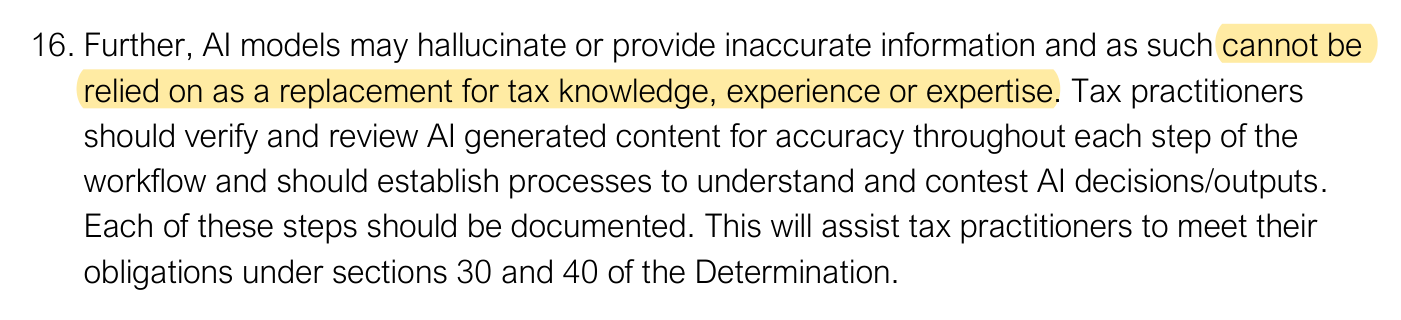
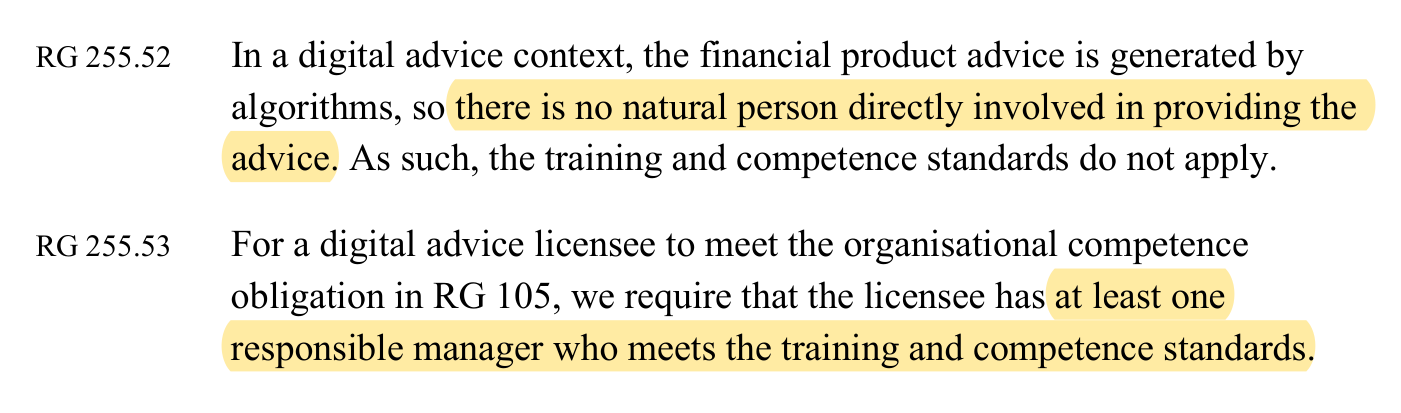
ASIC went furthest, years ago. Its guide on digital advice accepts that when advice is generated by algorithms, "there is no natural person directly involved in providing the advice"4. It didn't respond by exempting the algorithm. It requires the licensee to have at least one responsible manager who meets the training and competence standards for advisers4. The algorithm can give the advice. The licensee, and a qualified person inside it, answer for it.
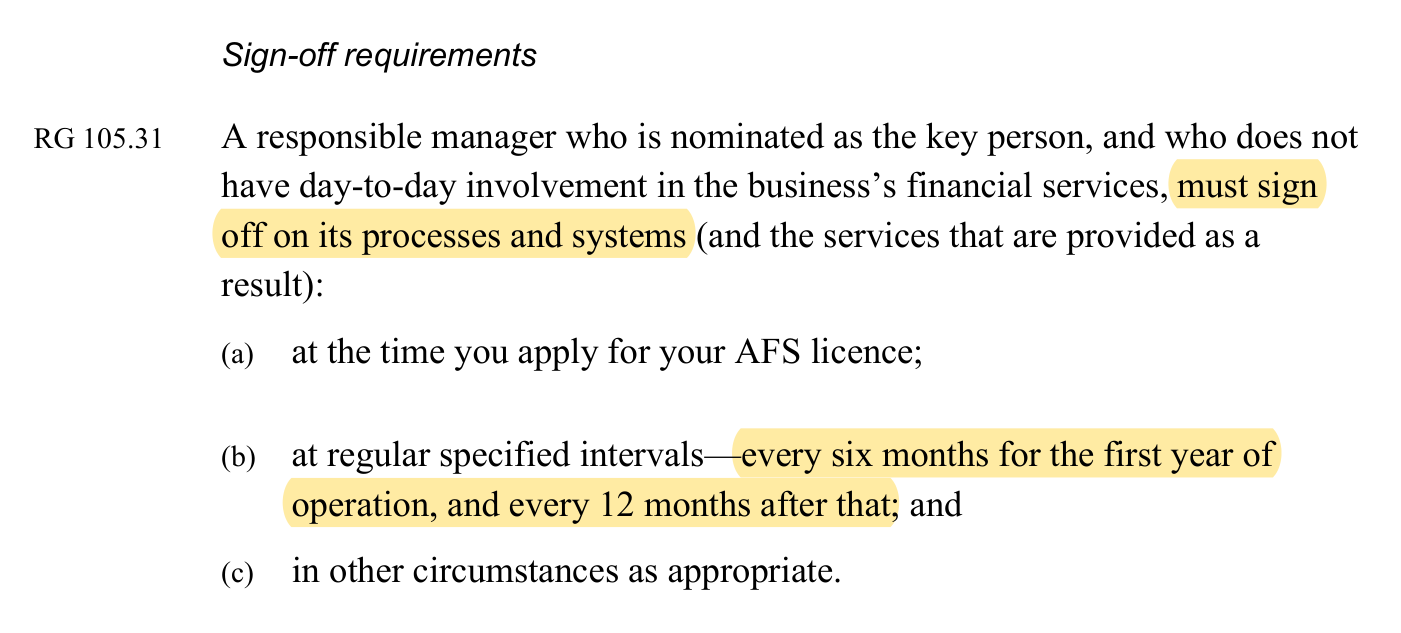
ASIC's guide on organisational competence goes a step further for the smallest automated firms. A small-scale, heavily automated licensee, one that relies on algorithms with "extremely limited human discretion" and has served fewer than 1,000 retail clients, can nominate a responsible manager who isn't involved day to day3. That manager must sign off the business's processes and systems when it applies for the licence, every six months in the first year, every 12 months after that, and in other circumstances, such as material changes to the automated services3.
When it goes wrong, the licence takes the hit
This isn't theoretical. In a 2024 family law matter, a Victorian solicitor tendered a list and summary of authorities that had been generated with AI and, in the regulator's words, "provided inaccurate citations and summaries"19. On 19 August 2025 the Victorian Legal Services Board varied his practising certificate: he can no longer practise as a principal, handle trust money or run his own practice, and must complete two years of supervised legal practice19. In 2025 the Federal Court ordered a law firm to pay, on an indemnity basis, the costs the other side incurred because of the firm's use of AI in preparing two defective documents20.
Health works the same way. Ahpra received 13,327 notifications in 2024–25, up 19%, the largest rise since the national scheme began in 201011. Under the National Law, a notification is made about a registered health practitioner9, not about the software they used.
The registers are shrinking
If licensed people are the part that can't be automated, it matters how many there are. In several of these professions, the registers are going the wrong way.
New entrants are thin too. ASIC approved only 104 new credit licences in 2024–25, the fewest in any year since the regime began in 20115. These are counts of registrations and licences, not of people doing the work, but they are the counts that decide who is allowed to.
Health is short in a different way. Registrations are growing, but the modelling says not fast enough. Without further action, Department of Health modelling projects unmet demand for 7,700 GPs by 203313. The nursing workforce study's baseline projects an undersupply of 70,707 full-time-equivalent nurses by 203514. In the RACGP's 2025 survey, about one in three GPs said they intend to stop practising within five years15. In law, solicitor numbers grew 47% in a decade, but the share outside the cities fell from 12.5% to 8.8%17.
Put the two trends together. Software can take on a growing share of the groundwork, though how much can safely finish without a person varies by task. The licensed decisions, and the accountability, stay with licensed people and the businesses they stand behind, and in several fields those registers are shrinking. Licensed time is becoming the constraint.
So spend licensed time where the licence matters
Most licensed people today spend much of their day on work that doesn't need their licence. In the RACGP's 2025 survey, 77% of GPs were dissatisfied with the amount of administration in their work15. The same is true of the credit analyst gathering payslips, the solicitor assembling a chronology and the nurse chasing a missing consent form.
The model that follows is simple. Software does the reading, checking, chasing and drafting on every case, and keeps a record of what it checked. The licensed person gets the cases that need a licensed decision, with the evidence already gathered, and makes the call. They stay accountable for it, as they always were.
☛ ADM-4822 · illustrative
09:14
Referral and admission form arrive by fax. The engine reads both and opens the case.
09:16
Fund cover and consent check out. Warfarin listed with no stop date: flagged for a nurse.
09:40
The nurse calls the patient, decides, and signs. Her name goes on the case.
How far that stretches a licensed person depends on how much of the work can finish without them. In a simplified model, where every case takes the same time and a case that finishes on its own needs no review at all, the arithmetic is simple. If half the cases finish on their own, the same person can handle about twice the caseload. At 80%, about five times. Real review, supervision and exceptions take time, so treat that as an upper bound, not a forecast. The direction still holds: the same licensed team can oversee more work, with more of their day spent on the part only they can do.
Yet
None of this is permanent, and the edges are moving. In January 2026 Utah announced a pilot, under an agreement signed in October 2025, that lets Doctronic's AI system renew repeat prescriptions for about 190 listed medicines3036. In the pilot's first phase, a doctor authorises every renewal36. Utah's May 2026 report said the AI recommended renewal in 72% of cases, and the first reviewing doctor agreed in 91% of those37. Utah's own medical licensing board wrote in April asking for the pilot to be suspended38. A later phase could let the AI send eligible renewals straight to pharmacists, but only after 250 filled prescriptions per medication group and the regulator's approval36.
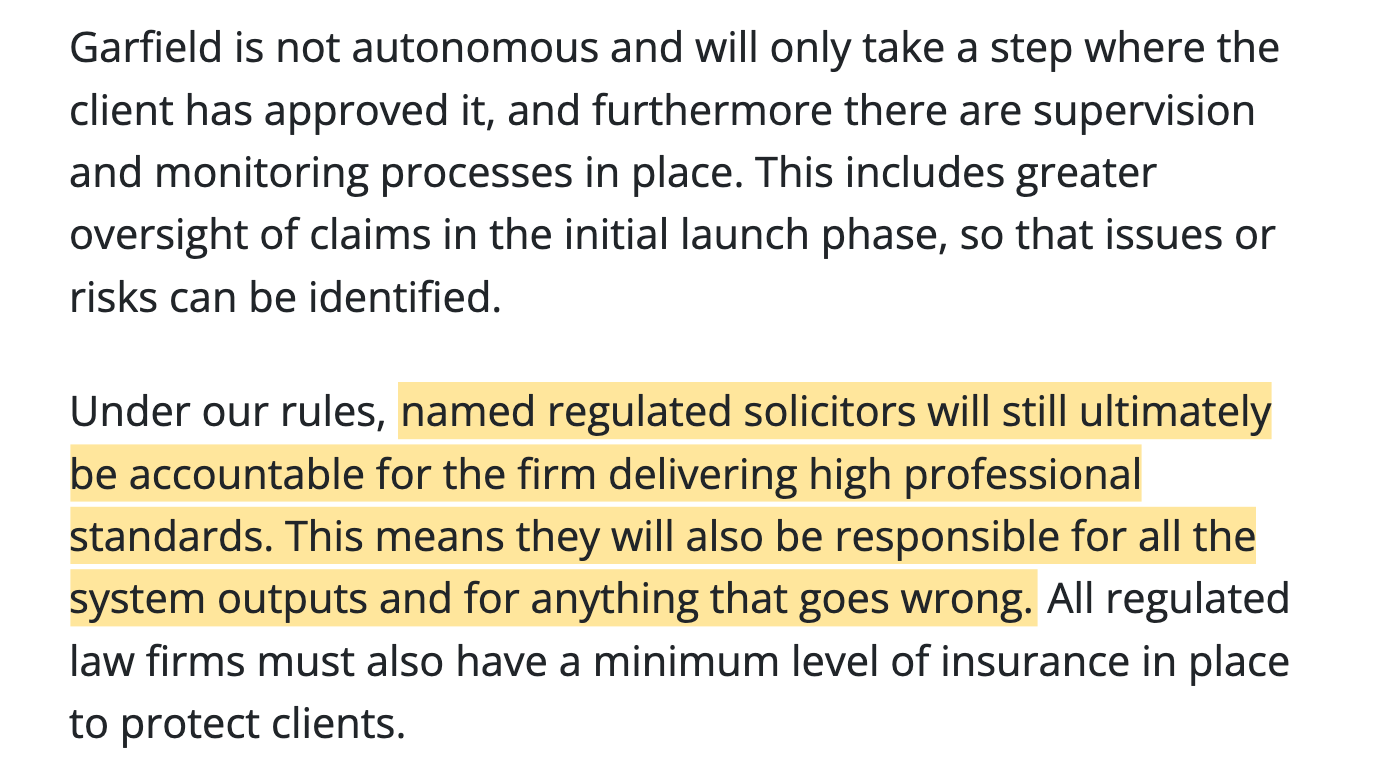
In May 2025 the Solicitors Regulation Authority in England authorised Garfield.Law, "the first purely AI-based firm we have authorised to provide regulated legal services"28. The SRA stresses that the system is not autonomous: it only takes a step the client has approved, under supervision and monitoring28. And the condition on the licence is explicit.
Courts have drawn the same line on who counts as a person. In Commissioner of Patents v Thaler, the Full Federal Court held in 2022 that only a natural person can be an inventor under Australia's Patents Act29, and in November 2022 the High Court refused special leave to appeal35.
That is what the frontier looks like: the machine does more of the work, and a licensed person or business still answers for it. Australia has chosen to govern AI mainly through its existing laws and regulators27, and the licensing regimes among those laws are written around people.
What this means if you run a licensed business
- 01Find the line. For each kind of case, write down which decisions the law or your licence reserves to a qualified person, and which are routine. Check the supervision, privacy and consent rules that apply. Most businesses have never drawn that line explicitly.
- 02Move the routine work to software, with a full record of what was checked and why, so the licensed person can review it, rely on it where that's appropriate, and defend it.
- 03Give every licensed person more reach, not more admin, so growth depends less on hiring people who are scarce, slow to train and expensive to replace.
The businesses that do well won't be the ones that try to replace their licensed people. They'll be the ones that give each of them far more reach. That's what we build with our clients: an engine that does the groundwork and hands your licensed people the decisions that need them, ready to make. If you'd like to see where that line sits in your business, start with a free conversation about how your cases arrive today.
Sources
- 1National Consumer Credit Protection Act 2009 (Compilation No. 52) · Federal Register of Legislation, 2026
- 2RG 206 Credit licensing: Competence and training · ASIC, 2020
- 3RG 105 AFS licensing: Organisational competence · ASIC, 2022
- 4RG 255 Providing digital financial product advice to retail clients · ASIC, 2016
- 5REP 825 Licensing and professional registration activities: 2025 update · ASIC, 2025
- 6Information Sheet 253: Claims handling and settling · ASIC, 2025
- 7Financial Advisers Dataset · ASIC via data.gov.au, 2026
- 8Quality of Advice Review: Final Report · The Treasury, 2022
- 9Health Practitioner Regulation National Law · Queensland Legislation, 2026
- 10Meeting your professional obligations when using Artificial Intelligence in healthcare · Ahpra and the National Boards, 2024
- 11Annual report highlights workforce growth and stronger safeguards · Ahpra, 2025
- 12Eligibility for health professionals (Medicare provider numbers) · Services Australia, 2026
- 13Impact Analysis: Building the GP Workforce · Office of Impact Analysis, PM&C, 2025
- 14Nursing Supply and Demand Study 2023–2035 · Department of Health and Aged Care, 2024
- 15General Practice: Health of the Nation 2025 · Royal Australian College of General Practitioners, 2025
- 16Engage in legal practice and legal services under the LPUL · Law Society of NSW, 2025
- 172024 National Profile of Solicitors · Urbis for the Law Society of NSW, 2025
- 18Practice Note SC Gen 23: Use of Generative Artificial Intelligence · Supreme Court of NSW, 2025
- 19Statement on the 'Mr Dayal' matter · Victorian Legal Services Board + Commissioner, 2025
- 20Murray on behalf of the Wamba Wemba Native Title Claim Group v State of Victoria [2025] FCA 731 · Federal Court of Australia, 2025
- 21Tax Agent Services Act 2009 · Federal Register of Legislation, 2025
- 22TPB(GS) 55/2026 The use of Artificial Intelligence and the Code of Professional Conduct · Tax Practitioners Board, 2026
- 23Corporations Act 2001 (Compilation No. 148) · Federal Register of Legislation, 2026
- 24Guidance on pharmacy business ownership, proprietary interests and undue influence · Victorian Pharmacy Authority, 2025
- 25Use of artificial intelligence (AI) · Office of the Migration Agents Registration Authority, 2026
- 26Our Gen AI Transition: Implications for Work and Skills · Jobs and Skills Australia, 2025
- 27National AI Plan · Department of Industry, Science and Resources, 2025
- 28SRA approves first AI-driven law firm · Solicitors Regulation Authority, 2025
- 29Commissioner of Patents v Thaler [2022] FCAFC 62 · WIPO Lex, 2022
- 30Utah and Doctronic announce partnership for AI prescription medication renewals (news release) · Utah Department of Commerce, 2026
- 31Registrant data: 1 April 2026 to 30 June 2026 · Medical Board of Australia, 2026
- 32Migration Act 1958 · Federal Register of Legislation, 2026
- 33Health Insurance Act 1973 · Federal Register of Legislation, 2026
- 34Legal Profession Uniform Law (NSW) · NSW Legislation, 2026
- 35High Court Bulletin, November 2022 (special leave results) · High Court of Australia, 2022
- 36Office of AI Policy: Doctronic regulatory mitigation agreement · Utah Department of Commerce, 2026
- 37Key statistics on the Doctronic pilot program · Utah Office of Artificial Intelligence Policy, 2026
- 38Letter from Utah's medical licensing board on the Doctronic pilot · Utah Department of Commerce, 2026
- 39Medicare Benefits Schedule Book, operating from 1 July 2026 · Department of Health, Disability and Ageing, 2026
- 40Migration agents activity report: January to June 2026 · Office of the Migration Agents Registration Authority, 2026
- 41Tax Practitioners Board Annual Report 2024–25 · Tax Practitioners Board, 2025
- 42Registrant data: 1 April 2026 to 30 June 2026 · Pharmacy Board of Australia, 2026